AI Fitness Side Hustle: Could Equipment Photos Become a Paid Service?
A photo of dumbbells is not a business. But helping people organise workouts and stay consistent could be a service worth testing. Here is the realistic beginner-to-full-time route.
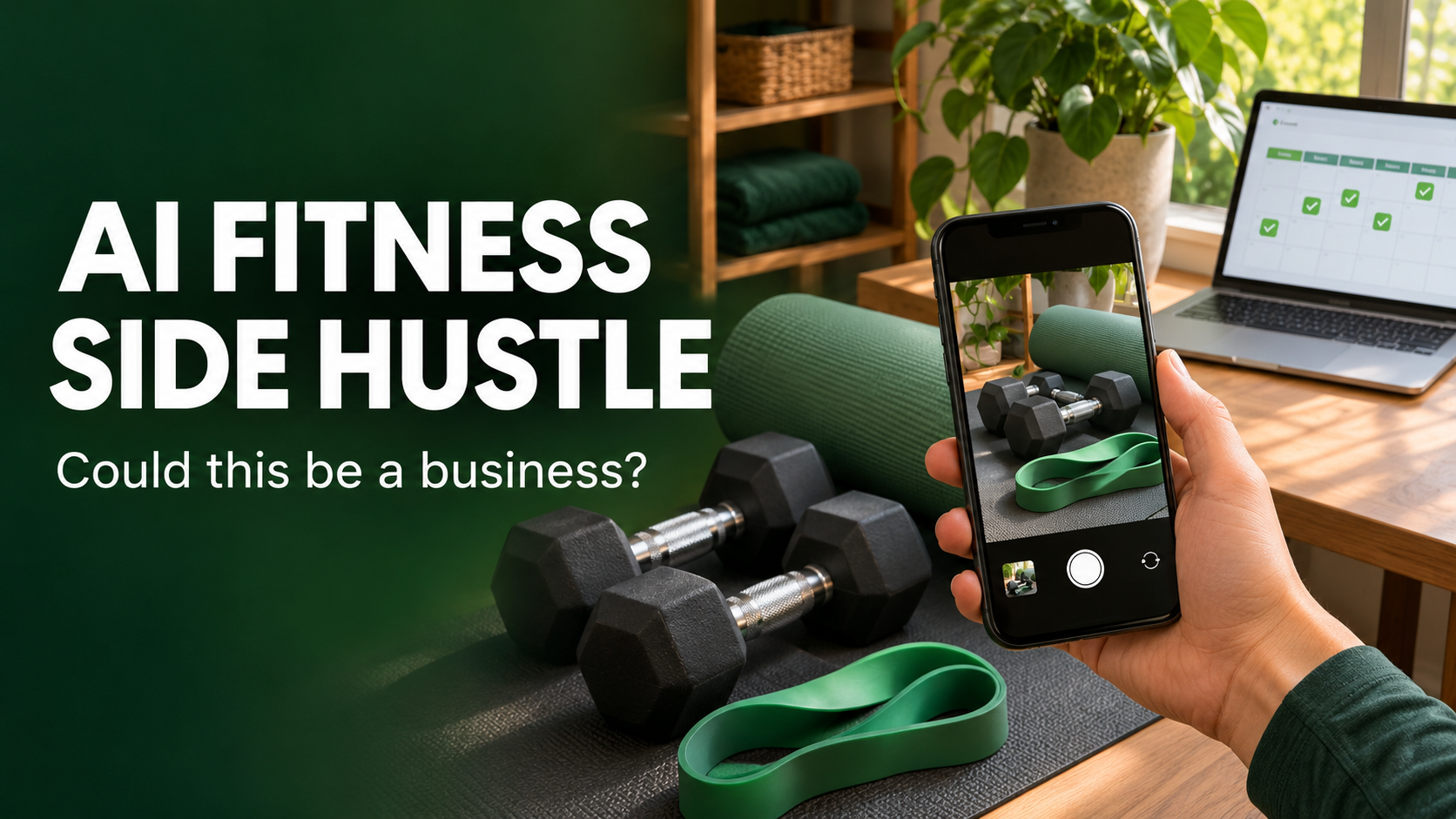
Someone sends you a photo of the dumbbells gathering dust in their spare room. Could you turn that into a paid service?
The tempting answer is simple: upload the picture to AI, generate a workout plan and charge for it. The problem is just as simple: your customer can ask a chatbot themselves. And an AI-generated plan is not proof that the exercises are right for that person.
The more useful idea is an AI-assisted fitness planning and accountability service: help people organise the equipment they have, follow a professionally approved programme and keep track of what they actually complete.
This is a business idea to test, not a proven GrabFinds income stream. Here is what the service could look like, who could deliver it and why the numbers matter before you try to grow.
What is an AI-assisted fitness side hustle?
Think of it as a service that connects a workout programme with someone's real schedule. The client may have equipment and a plan already. What they lack is a usable calendar, a simple progress log or dependable follow-up.
AI can help format information, prepare calendars and summarise completion logs. Your job is to verify the information, deliver a clear system and provide the support you promised. A qualified personal trainer handles personalised exercise programming and changes.
- The client shares equipment-only photos and confirms item names and weight labels.
- You organise the verified inventory and the trainer-approved programme.
- AI helps format a calendar and completion log without changing the training instructions.
- You check the output, deliver it and follow up at agreed times.
- The trainer reviews any proposed changes to exercise selection, loading or progression.
The customer is paying for useful organisation and reliable service. The AI tool is only part of how you deliver it.
Why photos are useful—and where they fall short
A picture can help start an equipment inventory. It does not tell you everything about a person's experience, technique, injuries or what they can safely lift. AI may also misread labels or identify the wrong machine.
Ask people to confirm the equipment details in writing. Keep photos focused on equipment rather than bodies, faces or other gym users. Avoid promising that a photograph alone can produce the perfect workout.
For example, a fictional client owns dumbbells and resistance bands and already has a trainer-approved three-day programme. You turn that approved programme into a calendar that fits their chosen days, then provide a log and agreed reminders. If they miss a session, you record the obstacle and help with scheduling within the trainer's instructions. You do not invent a harder workout to compensate.
Can a beginner start this?
A beginner can first learn the administrative side: spreadsheets, calendars, clear communication and checking AI output. Build a sample using your own equipment and fictional information before collecting customer data or charging anyone.
If you want to design and sell personalised exercise programmes, build the relevant competence and insurance arrangements or work with a qualified trainer. CIMSPA identifies a Level 3 Certificate or Diploma in Personal Training as a qualification route. An AI subscription is not a substitute for that expertise.
There are therefore two practical directions:
- Support clients: organise existing approved programmes and provide clearly defined accountability.
- Support trainers: help qualified professionals prepare calendars, logs and administrative summaries under their direction.
The second route is worth testing because the trainer already supplies the programming expertise. You must still agree responsibilities, data handling and payment clearly.
Start part-time before you think about full-time
Start with a small pilot, not a custom app. Prepare one sample, show how it works and invite up to three adults to try a clearly defined seven-day service. Explain what is included and what would cost money afterwards.
Use your own social accounts or groups that allow offers. Demonstrate the process: equipment inventory, readable calendar and completed log. Avoid invented before-and-after photos or promises of a guaranteed transformation.
Then ask the question that matters: will they pay to continue?
If they enjoy the free trial but nobody pays, you have feedback—not a validated business. Improve the offer or stop before spending more.
What could you charge, and what would you keep?
One introductory price test could be £15 for an equipment inventory, calendar and tracker setup, with £25 a month for limited reminders and a weekly administrative check-in. These are hypotheses, not market rates or quotes for qualified personal training. Professional trainer input needs its own costed arrangement.
At £25 per month, ten clients produce £250 revenue before costs and tax. If each needs 20 minutes a week, delivery alone takes about 14.4 hours a month. That is roughly £17.30 per hour before software, marketing, administration and other costs.
Promise daily manual support and those margins can disappear quickly. Record every minute, including messages, revisions, sales calls and bookkeeping. Use the GrabFinds Quick Profit tool to check what remains after expenses, rather than treating revenue as take-home pay.
Could it become a full-time business?
Potentially, but only if people pay, renew and can be served profitably. Fifty clients at an illustrative £49 per month would produce £2,450 monthly revenue. That is arithmetic, not a forecast. It does not deduct trainer fees, software, customer acquisition, tax or the time spent running the business.
Before reducing other work, look for sustained profit, repeat customers, manageable delivery hours and a reliable way to find new clients. Set a cash buffer that matches your own circumstances. One popular video does not establish a dependable income.
You may eventually build a qualified coaching service, a specialist administrative business for trainers or a more focused accountability offer. Grow the version customers actually value.
Three things to get right from day one
- Be honest about your role. State your qualifications and what you provide. Personalised exercise decisions need appropriate professional expertise.
- Protect client information. Start with minimal data and equipment-only images. Do not upload identifiable client photos or health details to AI tools without an appropriate process and permission for the sharing.
- Check every output. AI can change numbers, omit instructions or invent details. Compare the calendar with the approved original before delivery.
Health information has additional UK data-protection requirements. The ICO explains that special category processing requires an Article 6 lawful basis and an applicable Article 9 condition. Explicit consent can be one condition, but it is not the entire process. Keep medical screening and specialist advice with the appropriate professional.
Your first step: build one useful sample
You do not need a new website, paid ads or a large following to make a sample. Create an equipment list, a calendar layout and a blank log. Show someone how the system works and find out whether it solves a problem they care enough to pay for.
GrabFinds has prepared an accompanying side-hustle guide, AI-Assisted Fitness Planning & Accountability, and a complete tutorial, How to Start an AI-Assisted Fitness Business: Beginner to Part-Time and Full-Time. Together they cover the workflow, copyable AI prompts, finding clients, a part-time schedule and the numbers needed for growth.
Explore the GrabFinds side-hustle collection and step-by-step tutorials, or join GrabFinds free to take part in the community. The accompanying fitness guides are being prepared for release.
Would you find more value in a workout calendar, progress tracking or someone helping you stay consistent? Share which problem you would want the service to solve.
Sources
Prepared 16 November 2026. This article explores a business model; it is not an individual training plan. All prices and revenue examples are illustrations to test. Earnings and fitness outcomes are not guaranteed, and GrabFinds has not verified earnings from this model.
Support Independent Side Hustle Testing
Enjoying our free guides and real-world experiments? Your voluntary support helps us test more ideas and share the results.
☕ Support GrabFinds on Ko-fiCompletely optional. Free membership remains free.
Comments
Log in or join GrabFinds to leave a comment.