
How to Start an AI-Assisted Fitness Business: Beginner to Part-Time and Full-Time
A practical UK guide to equipment photos, AI-assisted workout organisation, trainer partnerships, first clients, part-time delivery and building a sustainable full-time service.
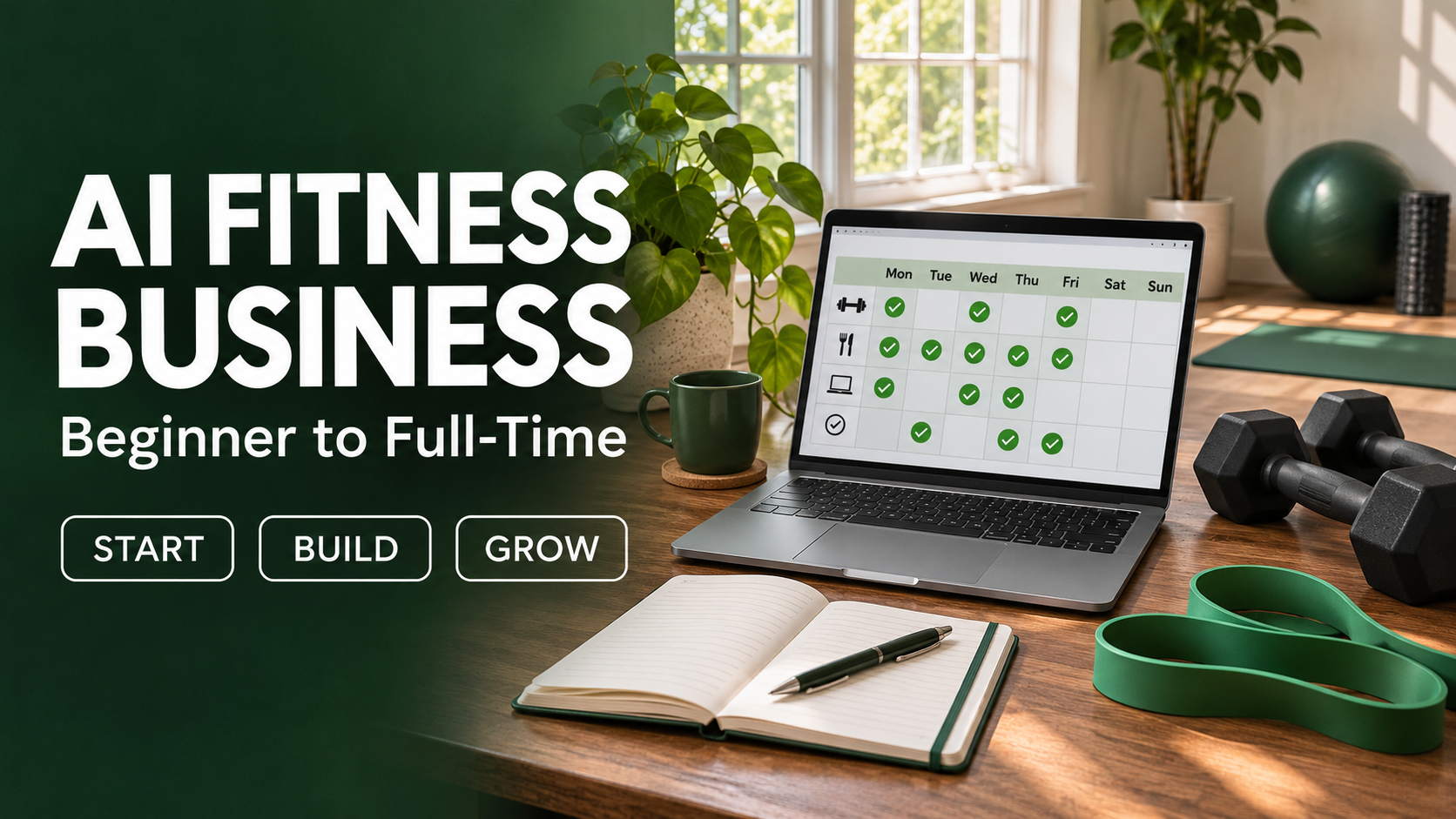
You can use AI to help organise a fitness service around equipment people already own or use at a gym. But copying a chatbot's workout and charging for it is a weak business. Customers pay for a clear process, dependable support and appropriate expertise.
This tutorial takes you from a beginner sample to a part-time service, then explains what must be true before going full-time. It is an untested business model, not a GrabFinds earnings result or an individual exercise prescription.
1. Beginner: choose what you are qualified to deliver
Choose one of two routes before accepting clients:
- Organisation and accountability: help adults put an existing trainer-approved programme into a calendar, organise equipment lists, maintain logs and receive agreed reminders. You do not select exercises, prescribe loads or change progression.
- Personal training with AI support: become appropriately qualified and insured, or partner with a qualified personal trainer who handles assessment, programming and reviews. AI helps with administration; a competent professional remains responsible for individual training decisions.
CIMSPA describes a Level 3 Certificate or Diploma in Personal Training as a qualification route. Check provider recognition, prerequisites, practical assessment, costs and the cover your insurer requires. A short AI course does not make you a personal trainer. Qualification study time is additional to the launch tasks below.
Begin with adults and a narrow need, such as people who already have an approved home programme but struggle to follow it. Do not start by promising rehabilitation, medical diets or guaranteed transformations.
2. Build your first sample before buying anything
- Use your own equipment or a made-up example. Photograph equipment only. Avoid faces, bodies, addresses and other gym users.
- Write down each item, its label and available weights. Confirm the list manually: AI may misread a weight or identify a machine incorrectly.
- Create a spreadsheet with these tabs: Equipment, Approved Programme, Calendar, Completion Log and Weekly Summary.
- Use a fictional programme supplied for demonstration, or a real programme you have permission to use. Label a fictional sample clearly and do not present it as suitable for a reader.
- Ask AI to format the approved information without changing the programme. Compare every instruction against the original.
- Deliver a readable calendar, a blank completion log and one example weekly summary. Test them on a phone.
You need a phone or laptop, a spreadsheet, calendar and document template. Existing free tools can cover basic administration. Qualifications, insurance, secure storage, paid software and trainer fees are separate costs. Get actual quotes before setting your final prices.
Copyable AI prompt: organise an approved programme
Act as an administrative assistant. Use the verified equipment inventory, available days and trainer-approved programme below. Create a weekly calendar and completion log. Preserve exercises, loads, repetitions, rest periods and progression instructions exactly. Flag missing information instead of guessing. Do not prescribe exercises, change the programme or infer health from images. Return a list of anything requiring the trainer's approval.
Use anonymised information. Review the output manually before sharing it.
3. Turn the sample into a clear offer
A simple starting offer is: “I organise your existing workout plan into a calendar and progress tracker, then help you stay on top of agreed check-ins.” Explain that AI assists the administration. Do not imply that you are qualified if you are not.
- Setup: verified equipment inventory, approved-programme calendar and log.
- Monthly support: agreed reminders and one weekly administrative review.
- Limits: response hours, number of revisions, what the trainer handles and how the client ends the service.
Test £15 for setup and £25 a month for limited support only as introductory price hypotheses. These are not market averages, recommended earnings or quotes for professional personal training. Trainer-delivered programming needs a separate costed offer.
Do not promise unlimited messages or daily manual coaching at a price that cannot cover your time. Obtain clear agreement to charges and renewal terms; do not start automatic billing without permission.
4. Find your first three pilot users
- Record a short screen demonstration: equipment photo, confirmed inventory, calendar and log. Use your own material.
- Post it on your own TikTok, Facebook or YouTube account. In groups, check permission before posting an offer.
- Invite up to three adults who already have a suitable programme to try a defined seven-day pilot. Explain what is free and what would cost money afterwards.
- Alternatively, approach qualified trainers with an administrative support offer: client calendars, log preparation and weekly completion summaries under their direction.
- Ask what was useful, what was confusing and whether they will actually pay for continued support. A compliment is not a sale.
Example invitation: “Already have a workout plan but struggle to keep track? I am testing a service that turns your approved plan into a simple calendar and progress log, with agreed check-ins. I am looking for three adults to try it for seven days and give honest feedback. This is organisation support; exercise advice stays with your trainer.”
Do not invent testimonials or body-change results. Use a testimonial only with permission and describe the actual service delivered.
5. Deliver the service step by step
- Agree scope: deliverables, price, contact schedule, cancellation terms and professional boundaries.
- Collect the minimum: equipment list, available times, approved programme and contact preference. Keep medical screening with the appropriate professional using a suitable process.
- Verify equipment: ask the client to confirm names and weight labels. An image cannot establish whether equipment is safe or suitable.
- Prepare the pack: calendar, original programme reference and completion log. The trainer approves personalised programming and any proposed training changes.
- Check in: ask whether the planned session was completed and whether scheduling support is needed. Do not automatically generate a different workout every day.
- Review weekly: summarise completion, practical obstacles and agreed next steps. Refer pain, injury concerns and exercise changes to an appropriate professional.
Example client journey
A fictional client has dumbbells, bands and an existing trainer-approved three-day programme. They send equipment-only photos and confirm labels. You arrange the approved sessions around their chosen days and create a log. After a missed session, you record the reason and ask whether they want help reorganising the calendar within the trainer's instructions. You do not invent extra exercises or increase the weight.
Copyable AI prompt: weekly summary
Summarise this anonymised completion log. Report planned sessions, completed sessions, client-reported scheduling obstacles and questions for the trainer. Do not diagnose, assess exercise technique or change training. Distinguish recorded facts from missing information. Keep the summary under 150 words.
6. Run it part-time with a fixed weekly schedule
Start with three to five clients and a capacity limit. As an example, reserve two hours for weekly reviews, one hour for setup, one hour for enquiries and one hour for administration. Offer response windows you can actually keep around your other job.
- Monday: review logs and send agreed weekly summaries.
- Wednesday: prepare new calendars and handle trainer-approved revisions.
- Friday: answer enquiries, record finances and review delivery time.
- At agreed times: send scheduled reminders and check for messages requiring professional referral.
Track all work, including unpaid sales calls, revisions, messages and bookkeeping. Five clients at £25 produce £125 monthly recurring revenue, before setup fees, costs and tax. Ten clients produce £250. Neither figure is take-home pay.
At 20 minutes per client per week, ten clients need about 14.4 delivery hours per month, using 4.33 weeks. £250 divided by 14.4 is about £17.30 an hour before software, marketing, administration and other expenses. If you spend an additional five hours, it falls to about £12.90 before costs. Daily manual support can destroy the margin.
At the end of the first month, check: how many pilots paid, how many renewed, why people cancelled, average minutes per client and profit after actual costs. If nobody pays or renews, change the offer before adding more tools.
7. Improve the offer before trying to scale
After several paying clients renew, standardise the inventory form, calendar template, message schedule and quality checks. Separate routine administration from decisions that require a trainer. Keep one source of truth for the approved programme and version changes.
Test better pricing with new customers when the evidence supports it. For example, £49 per month for a clearly defined administrative service is a price experiment, not an established market rate. Ask customers what value they receive and calculate whether the offer covers acquisition, support and cancellations. Do not add professional coaching to justify a higher price unless you can competently deliver it.
A trainer partnership can create a clearer division of work. Agree responsibilities, payment, client communications, data handling, approval turnaround and cover during absence. Price using the actual trainer fee and service workload.
8. Full-time: calculate the business you would need
Full-time is a capacity and profit decision, not a follower milestone. Illustrative arithmetic: 50 clients at £49 per month generate £2,450 monthly revenue. If delivery averages 20 minutes per client each week, that is about 72.2 hours per month before sales, administration, holidays and other work.
If actual monthly business costs were £500, £1,950 would remain before personal tax, National Insurance, pension, unpaid leave and any other omitted costs. The £500 is an invented modelling assumption, not a cost estimate. Replace it with quotes and your records; trainer fees may make costs much higher.
Use this formula: required clients = round up((desired monthly business profit + monthly business costs) ÷ average monthly revenue per client). Then test whether those clients fit your delivery capacity. The formula is simplified: cancellations, discounts, bad debt and changing costs must also be modelled.
A practical growth gate is several consecutive profitable months, evidence of renewals, a repeatable way to acquire clients and enough cash to cover a quiet period. Before reducing other work, decide your own minimum income, cash buffer and acceptable risk. Do not quit because one post performed well or one month looked good.
- Track enquiry-to-paying conversion and acquisition cost.
- Track renewals and cancellations; replace lost clients before forecasting growth.
- Limit clients to the hours you can serve well; include cover for illness and leave.
- Use software for reminders and summaries only after testing consent, accuracy and the human review process.
- Consider supporting several qualified trainers rather than personally messaging hundreds of low-price clients.
9. Business records, privacy and professional limits
Keep income and expense records from the start. Check current HMRC guidance for your existing employment and self-employment circumstances. Do not assume each new side hustle gets a separate trading allowance. Check appropriate insurance, written service terms and responsibilities before taking payment.
Collect equipment-only photos wherever possible. Do not infer health, body fat or fitness from a body image. Health information has special protections under UK GDPR: processing needs both an Article 6 lawful basis and an applicable Article 9 condition. Explicit consent may be one condition, but permission alone is not a complete compliance process. Explain which providers receive data, minimise identifiable information, check retention and model-training settings, secure access and set deletion rules.
AI can invent instructions and alter numbers. A disclaimer cannot replace qualifications, appropriate insurance, professional judgement or review. Personalised programme design and progression stay with the qualified professional. Do not diagnose injuries or sell rehabilitation or medical diets outside your competence.
10. Your first 30 days
- Week 1: define your scope, choose one audience, make your own sample and list real startup costs. Arrange trainer input if required.
- Week 2: demonstrate the service and invite three pilot users through permitted channels. Agree the process before collecting information.
- Week 3: deliver the pilot, check every output and record all time. Ask for honest feedback and test payment for the next period.
- Week 4: deliver to paying clients, review cancellations and calculate profit. Decide whether to improve, continue or stop. Qualification-dependent services must wait until the necessary competence and arrangements are in place.
Beginner milestone: one complete sample and a clear service boundary. Part-time milestone: paying clients who renew and a delivery process that fits your hours. Full-time milestone: sustained profit, retention and enough demand and capacity to meet your own income target.
Sources and further reading
- CIMSPA: personal trainer role and qualification routes
- ICO: special category data rules
- GOV.UK: becoming a sole trader
- GOV.UK: self-employed business records
Checked 16 November 2026. All business prices and scenarios in this tutorial are illustrations to test, not earnings guarantees. GrabFinds has not verified revenue from this business model.
Related side hustle
View the full side hustle guideWant to come back to this?
Save it to your free GrabFinds account and come back whenever you're ready.
Save this guideFree account · No card required
Comments
Log in or join GrabFinds to leave a comment.